
CozyXS™ Prestained Protein Ladder - low-range (2-40 kDA) ladder for protein electrophoresis and Western blots
Applications
- Approximate protein molecular weight determination on denaturing gels.
- Monitoring of electrophoresis process and Western transfer efficiency.
Benefits
- Low-range protein ladder with 3-color bands from 2 to 40 kDa
- Room-temperature-stable ladders, always ready to use.
- Sharp bands, bright colors.
CozyXS™ Prestained Protein Ladder
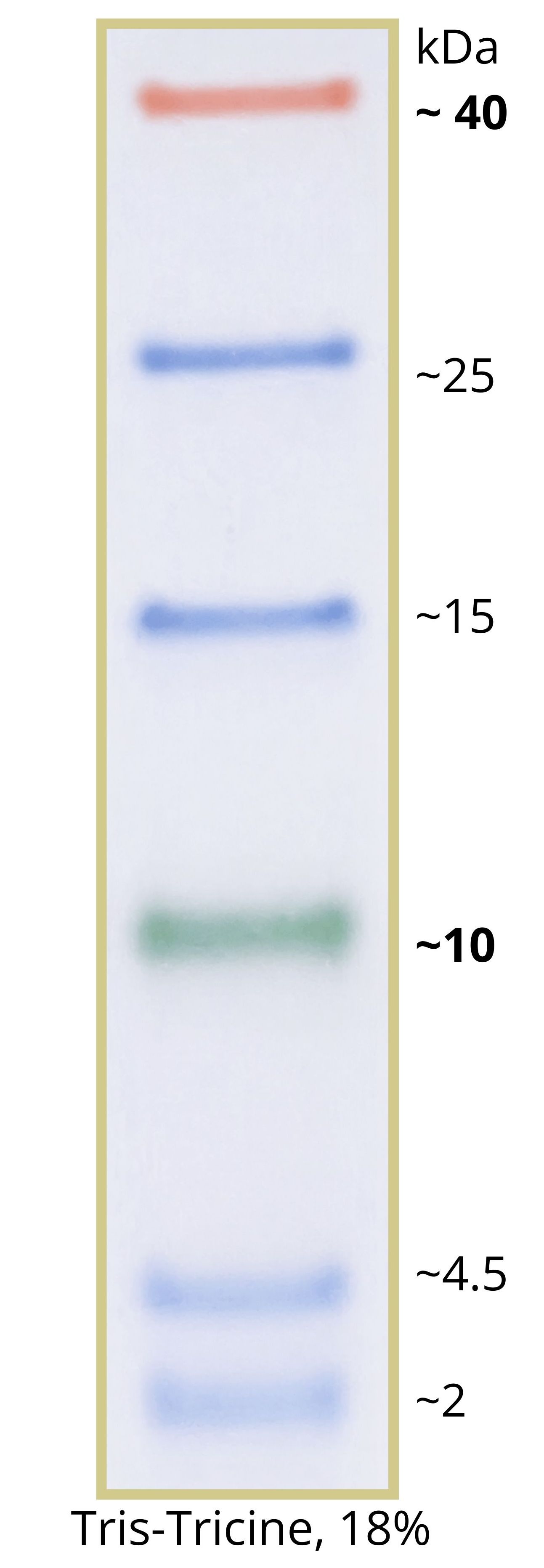
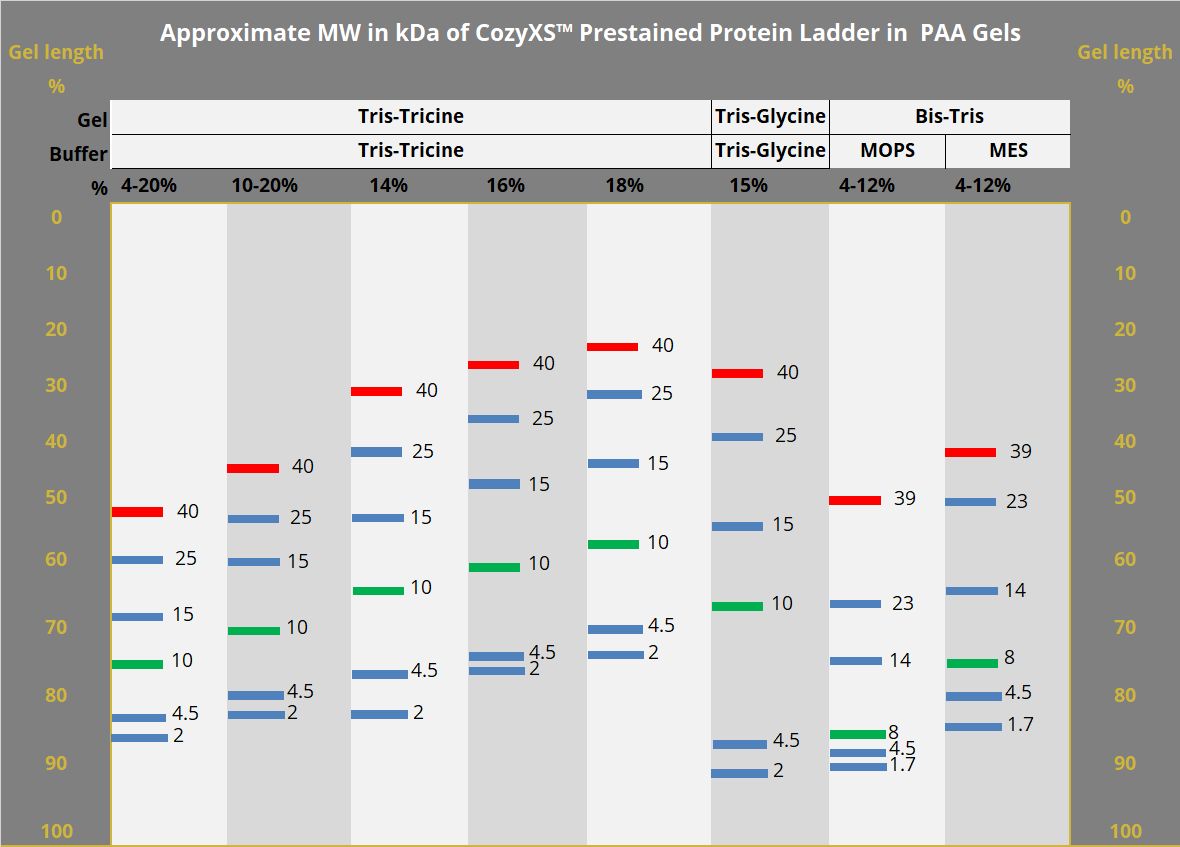

Product information "CozyXS™ Prestained Protein Ladder "
highQu ready to use Prestained Protein Ladders are mixtures of highly recombinant proteins with coupled chromophores providing sharp protein bands and bright colors on denaturing polyacrylamide gels. The high ladder purity allows for exceptional stability and room short term temperature storage. Ladders are ready to be directly loaded on gels without any preparation or heating. They provide sharp bands for approximate protein sizing and allow for monitoring of electrophoresis process and Western transfer efficiency.
This ready to load low-range CozyXS™ Prestained Protein Ladder contains six highly purified prestained proteins in a range from 2 to 40 kDA, supplied denatured in 20 mM Tris-Phosphate (pH 7.5 at 25°C), containing SDS, Urea and DMSO.
Recommendations for use:
- Do not heat, just thaw (if needed) and mix.
- Load: 3- 5 μl/ gel well for electrophoresis
- Load: 3- 5 μl/ gel well for Western transfers Gels
The ladder is separated well on 14 to 18% Tris-Tricine gels.
To separate low MW proteins on Tris-Glycine gels:
• Use 29:1 or 37.5:1 acrylamide to bisacrilamyde ratio.
• Use 15% acrylamide gel for separating small proteins
• If >15% gels are necessary, keep stacking gel layer thin (<5 mm)
• Use special gel loading tips to accurately load samples at the well bottom.
• For better stacking of small proteins, run electrophoresis at 100V for 15 min. followed by 150V for 60 minutes.
For Western transfer, use 100 V power for 90 minutes.
• For small proteins, use rather NC membranes with small pores (0.2 μm).
• Transfer Buffer: 25 mM Tris, 192 mM glycine, 25% methanol.
• Avoid SDS in transfer buffer and use methanol concentration up to 25% for better binding. Alternatively, take ethanol for binding of small proteins.
• After transfer, rinse the membrane with distilled water and proceed with blocking, washing, and incubation at 4°C.
• If further immobilization of small peptides on membrane is required, dry membranes at room temperature before blocking.
• Use Tween-20 at < 0.1% in washing and blocking buffers.
STORE
Room temp., short term (2 weeks)
+4°C, 3 months
-20°C, 12 months
Storage recommendations are just guidelines; the expiry date shall be followed.
Note:
The picture shows just guidelines for approximate protein MW estimation.
The apparent MW of each protein was determined by callibrating it against unstained protein of same size. For more precise sizing, such calibration shall be done exactly at conditions used.
- Download Protocol and Specifications - Product Insert CozyXS™ Prestained Protein Ladder
- Ask for a Sample today
- Have technical questions? Contact us
- Download a list of Publications mentioning highQu products
- Or see how others use our products at bioz.com or google scholar
- Download Protocol and Specifications - Product Insert CozyXS™ Prestained Protein Ladder
- Download MSDS CozyXS™ Prestained Protein Ladder
- Need a lot-specific Certificate of Analysis? E-mail us at info@highQu.com
- Want custom formulations or bulk sizes? E-mail us at info@highQu.com, and check our OEM offers
- Have more specific questions? Contact us
- Download Protocol and Specifications - Product Insert CozyXS™ Prestained Protein Ladder
- Download MSDS CozyXS™ Prestained Protein Ladder
- Download highQu Catalogue of Premium Research Tools
- Download a list of Publications mentioning highQu products
- Or see how others use our products at bioz.com or google scholar
- Download Product Pricelist
- Download all highQu Product Inserts and MSDS sheets
- Have questions? Contact us
Related Products

Our improved 2X 1Step RT qPCR Probe Kits provide highly sensitive target RNA detection when working with a wide variety of samples. The optimized 1Step RT qPCR Pro Mix in combination with a blend of thermostable Reverse Transcriptase and an advanced RNase Inhibitor (RT-Pro Mix) allows for a single step, one tube RT qPCR with great results even in multiplex reactions. The novel RT-Pro Mix ensures safe and efficient RNA template conversion into a single-stranded cDNA. Pure RNA samples, as well as lysed crude samples can serve as templates for one-step RT qPCR. Though the kit was not specifically designed for crude sample qPCR, it has a potential to work well for this application. The robust 1Step RT qPCR Pro Mix is a 2X concentrated qPCR master mix which includes dNTPs, buffer, and the hot start Taq DNA Polymerase. The Hot Start function ensures the highest sensitivity and specificity under both standard and fast qPCR cycling conditions. The kits provide excellent results on both AT and GC-rich templates and show early Ct values with minimum or no optimization. Our kits include PCR Water to guaranty the best performance. To suit the broad instrument range the 2X 1Step RT qPCR Probe Kits are available in three versions – without ROX, with low or high ROX concentration.

highQu ALLin™ Taq DNA Polymerase is the versatile engineered enzyme which in combination with the optimized ALLin™ buffer provides higher success rates in demanding PCR applications like amplification of complex templates, crude sample PCR and fast cycling. ALLin™ Taq DNA Polymerase has the same PCR accuracy like Taq DNA Polymerase, 4.5 x 10^4 (a number of correct nucleotides incorporated before the error occurs) and produces A-tailed products suitable for ligating into TA cloning vectors. The convenience of ALLin™ Taq DNA Polymerase is maximized by the use of 2X Red Mastermix providing the additional advantage of reduced pipetting and minimized errors. ALLin™ Red Taq Mastermix, 2X is premixed with red dye and density reagents for direct loading on the gels after the PCR. In a 2% agarose TAE gel the dye migrates with~350 bp DNA, in 1% agarose TAE gel with ~ 600 bp DNA fragments. The mastermix is even supplied with the PCR Water, and the only thing to add is the template with primers.

highQu dNTP sets and mixes meet all highest industry standards and allow for unrivaled performance of your PCR and other DNA synthesis, labeling or sequencing reactions. Produced under the stringent quality monitoring conditions, they guaranty reproducible results. More than 99% HPLC purity eliminates inhibitions of PCR and allows for increased yields with higher dNTP concentrations. Exceptional stability of dNTPs allows for short term ambient temperature shipments, short term room temperature storage or long PCR of more than 30 kb targets, as well as long amplifications exceeding 40 cycles.
highQu Taq DNA Polymerase is the classical enzyme for routine PCR applications providing high amplification yields of 3-5 kb targets under various conditions. Taq DNA Polymerase is purified from a recombinant E. coli strain carrying the Taq DNA polymerase gene. Taq DNA polymerase is thermostable 5´ → 3´ DNA polymerase. It lacks 3´ → 5´ exonuclease (proofreading) activity and has low 5´ → 3´ exonuclease activity. Polymerase exhibits deoxynucleotidyl transferase activity resulting in A-overhang at the 3'-ends of PCR products and allowing for TA cloning. The PCR accuracy of Taq DNA Polymerase is 4.5 x 10⁴ (a number of incorporated nucleotides before the first error occurs). The supplied reaction buffer for most flexibility in optimization, contains no dNTPs and no magnesium. The 50 mM MgCl2 solution is provided separately what allows for magnesium optimization starting from 1 mM up to 4 mM final concentration upon the need. The dNTPs in sets or mixes can be purchased from highQu separately. The most widely used PCR enzyme is the DNA polymerase from Thermus aquaticus. Taq DNA polymerase amplifies template DNA by adding nucleotides to the 3' end of a DNA strand in a template-dependent manner where short single-stranded primers that anneal to the template provide a starting point for polymerization. The enzyme has a 5' - 3' polymerase activity and lacks 3' - 5' exonuclease or so-called proofreading activity. For optimal performance, Taq DNA polymerase requires not only template DNA and reverse and forward primers, but also such essential PCR reaction components as deoxyribonucleotide triphosphates (dNTPs), and magnesium chloride. Optimized buffers commonly supplied with commercial Taq Polymerase enzymes contain certain salt concentration and have balanced pH value. Taq DNA polymerase has several other advantageous properties over other enzymes used for the PCR. It is known for a high stability and resistance to PCR inhibitors. The inhibitor resistance allows performing direct PCR reactions from crude non-purified templates, such as colony PCR. At highQu, Taq DNA Polymerase is either available as a stand-alone enzyme supplied with a ALLin™ Buffer, or as a convenient 2X concentrated master mix formulation.